I have had recent events in my life happen, that did not shake my Faith, but merely strengthened it; while I saw the same exact events unfold in the eyes of others, and leave their Beliefs shaken... Leading me to the contemplation that BELIEF and FAITH are two different things, and then it reminded me of reading the Philosopher Soren Kierkegaard whom contemplated this very subject; so why re-invent the wheel?
What is the "leap of faith" according to the Philosopher Kierkegaard?
Soren Kierkegaard's (who coined the phrase) philosophy on Leap of Faith is rooted in the distinction between Belief and Faith. This philosopher argued the merit of faith in God. In fact, he asserted that life is only worth living if you have total FAITH in God. According to Kierkegaard, BELIEF is reserved for things that can be proven by evidence. On the other hand FAITH is reserved for things that lack evidence. Since he also agreed that God is beyond logic, proof, or reason, he had no trouble admitting it took a Leap of Faith to believe in God; after all lack of logic, proof or reason are the very things necessary for Faith to be FAITH.
In order to reach this kind of faith, which Kierkegaard did not deem impossible, he argued that one must be constantly busy with self-analysis and evaluation. What this statement means and implies is that rather than just going around saying I “Have Faith”, one must take a long good look at themselves. Faith is also circular, in that it takes Faith to have Faith, hence again described as a "Leap."
Interesting Factoid
Kierkegaard never used the term "Leap OF Faith", rather he describes how one can make a "Leap TO Faith."
I found the Video below a good representation of the point I've tried to make, though I am not Christian, and you might not be either... GOD or CREATOR may mean different things or come by different names, to different people. It is all relative to the one having the experience.
“We become Just, by doing Just acts; Temperate, by doing Temperate acts,” –Aristotle.
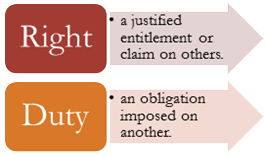
In Human Rights, according to H.J. McCloskey, a right may be an entitlement to do, to enjoy, to demand, to have done for us. Rights may be to act, to exist,or to demand. He went on to describe duties, as something negative, imposed on another, and that cannot be denied, if in fact, the another individual has a valid right under his claim. In this way, Rights and Duty are forever entwined always to impose on one another. An example in real life would be my right, given by the state, to Marry. Another cannot deny me my inalienable right, and therefore has a duty to perform said task, or request. Or just stand out of the way and not impede the process. Whichever the case might be.
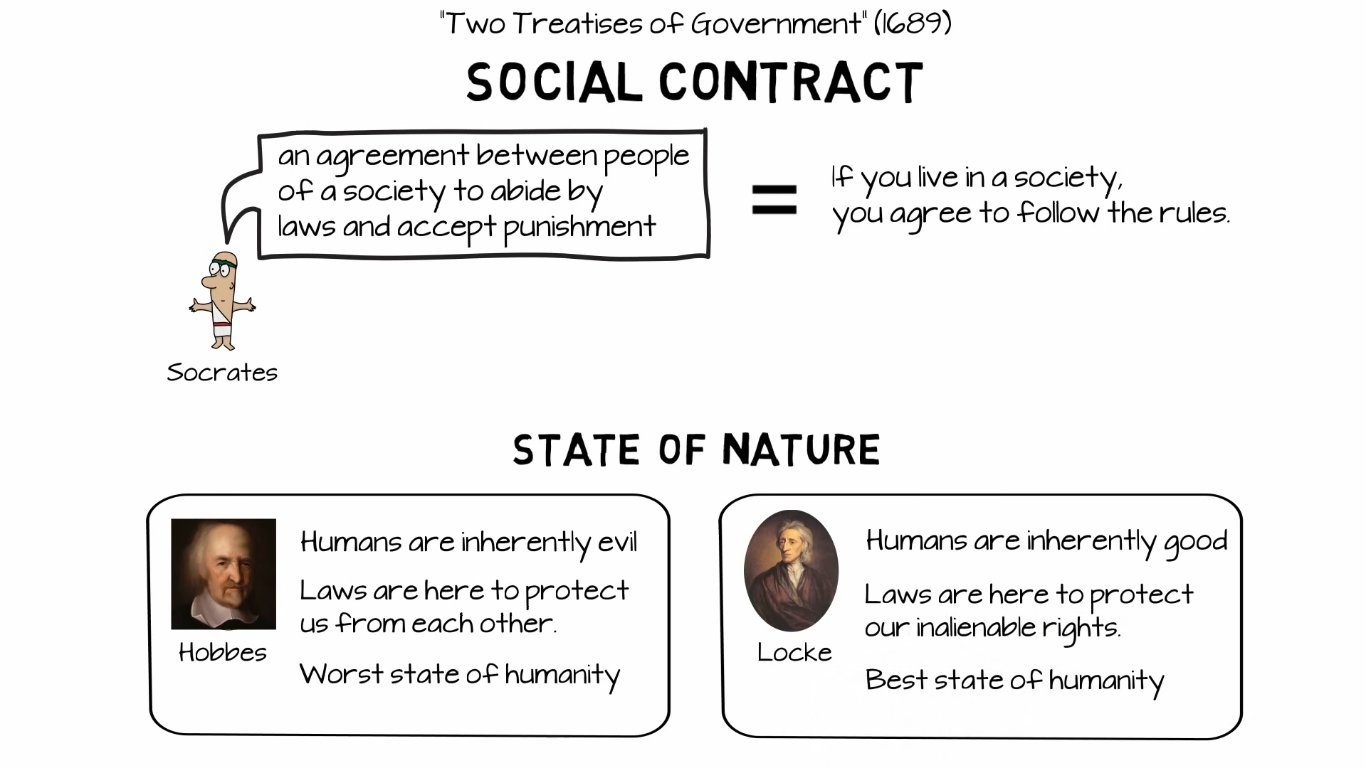
A Contract is an agreement between two parties. We enter into contracts every day, when we buy a house, car, get married, etc. Societies are controlled by governments. The general idea is that people benefit from living together in a group, or society governed by a body with rules and laws. When you live in society, you give up certain Rights(or freedoms), like the right to kill someone without punishment, in exchange for protection against another’s trespass of the law against you. People enter into an unspoken Social Contract every time they move into a new place. There are new people, new rules, and new processes.
The ’General Will’ is a new type of Social Contract. The idea of the ‘General Will’ was constructed by Jean-Jacques Rousseau. This new idea was intended to ensure that citizens did not feel like they had to make decisions, based off of what the majority wants. The majority does not rule. All decisions that are made should not be made based on individual desires. Instead, Rousseau offers that decisions should be made based on what the citizens feel is best for the community. Further, the theory follows with the assertion that everyone is born inherently ‘good,' and that selfish behavior and vanity are learned. Therefore, ‘General Will’ works because there is no coercion.
For example, if one citizen believes that there should be a raise in the minimum wage in their community so that there can be an economic stimulus growth. On the other hand, and another citizen is in conflict with this idea because they own a company and have many employees; therefore this would cost them a lot of money. The second citizen is acting out of self-interest, by worrying about their personal consequences, while the first is practicing the ‘General Will’ by placing aside their personal beliefs.
It reminds me of the television series Star Trek, where there is a character named “Spock,” and he is of a race called Vulcans. This race is ruled by logic and not emotions, and so he is always in some way or another quoting empirical philosophy and logic in his decisions. There are many episodes where he quotes the line “The needs of the many, outweigh the needs of the few,” which in itself is a Consequentialist Perspective.
David Hume stated that there are fundamental differences between Moral arguments and other kinds or arguments. The IS/OUGHT conundrum. This theory can be best broken down like this...
Rational Argument:All women are mortal. Krysisa woman. Therefore KrysIS Mortal.
Moral Argument:Seeing a woman get robbed is frustrating. Robbery is against the Law. It is wrong to Rob People, therefore we OUGHT not to Rob each other.
A statement using IS, can be considered a description of the world. A fact that someone may be able to confirm or deny through research or analysis. OUGHT on the other hand, is a value judgement, something which calls on preferences, perceptions, and intuitions.Neither which are necessarily universal. Although there is nothing wrong or irrational about OUGHT statements, we use them to describe if-then scenarios that depend on what a particular person wants or feels, which are called "Hypothetical Imperatives."
So for example if I want to make myself a sandwich (in the middle of the night as I write this. lol), then I OUGHT to get some bread to make it. You can confirm or deny this statement, and prove its validity with scientific method/ However, this scenario is dependent on person, time, and place; in-then scenarios, and might not hold to be universally true. This would be a rational statement.
In contrast, the truth or a Moral Statement is not supposed to depend on the opinions and values of the person saying it. It is usually more of a Categorical Imperative, like supported by philosopher Emmanuel Kant, that says:
"One’s actions can only be justified if it could be turned into a Maxims or universal law to be applied throughout the world."
Does your head hurt yet??? - Don't give up! There's a video at the end. lol.
Our first reactions to something might not be the most authentic expression of our values. This is how this article relates to REAL every day life.
HUME realized there was a gap, between the statements of fact of IS, and the Moral output of the OUGHT to question. A poignant observation that has been passed down in modern history as "to Assume, you make an ASS out of U and Me." Hume although a bit empirical in this methods of distinction in the IS/OUGHT problem "GAP" or Hume's Guillotine as it has come to be called, does not mean that he did not acknowledge that sometimes we CAN make OUGHT assertions from IS statements, and therefore fill the gap, although there is no empirical evidence pointing to those facts. He postured that this occurred through reason, and that by exercising one's rational mind, we could come to conclusions that perhaps we did not appreciate before. He used the example of ART, in saying that although we were all not inclined to like the same colors or patterns, that when we look at certain pieces of art, that normally we would "not like" sometimes we are taken by them, and it required a second look to fully engage and understand its meaning.
Similarly, when you watch a movie or read a book, that you think is dumb, but later discuss it with your friends and suddenly you have an epiphany and understand more than you initially did. Looking at things from a new angle (See my post on Perception).
Well... Here is something even MORE interesting! New advances in Neuroscience have now lead Philosophers to reject the old notions of the Aristotlean 5 senses. That... is another post all together!
As human beings, we appropriate the EGO to the driver's seat, while we relegate our built-in sense of collaborative or biological altruistic imperative to a standby witness, at best. As proof, there are immaculate examples of the ability to override this function, by what we perceive as humans to be extraordinary beings like Socrates, Copernicus, Leonardo DaVincci, Mozart, Mother Teresa, Gandhi, Einstein, Tesla, etc. All of these individuals felt like they were part of a ‘collective consciousness' which all interpreted differently (some as faith, others as art, or science), as they felt a call to a higher purpose, an altruistic one—for of the betterment and survival of the species via the anima of both physical and spiritual needs.
This exercise of the mind has left me excited and renewed with hope, that indeed the Human Condition may yet reach its full built-in potential (See posts on Human Collective). It seems that we have experienced in our recent present a modern ‘dark age' period, such as ones from ages in history, during which human consciousness appears to stunt its advancement, and retracts into selfish realms of being and existentialist pleasures. Similar to the controlled experiment, where slime mold exposed to periods of stress in anticipation of the stress, began to stunt its growth--I find the human collective has done the same (See Post on Slime Mold). Perhaps from these experiments, we can further gain insight into the implication that we are but individual pieces, like the mold nuclei, in the grand collective of the organism, that like the original example we have observed, make a whole.
The beauty of creation is that the design and intentions are seen in the world all around us, in the forms of both micro and macrocosms, we observe, as forms of objective truth. The golden ratio, also known as the divine proportion, or the golden mean is a complicated mathematical formula that is derived from the measurement of the distance between ratios, and appears in all forms of nature. Flower petals, sunflower seed heads, tree branches and root systems, all follow the Fibonacci sequence present in the golden ratio. Seashells, spiral galaxies, and hurricanes all follow the golden spiral in the same ratio. The length of our fingers, from the tip of the base to the wrist, follows the ratio of Phi. The measurement from the human navel to the floor and to the top of your head follows the golden ratio; so do the bodies of dolphins, starfish, ants, and honeybees. And to rest my case, I add that a DNA molecule's measurements of the double helix spiral exhibits and follows the Fibonacci sequence(link to Live Science and read more).
Can you accept the golden ratio as part of a deliberate, intelligent design; an objective truth that cannot be denied?
Subjectively we all decide what to believe after all that is what I think our free will allows. However the main point in all this cannot be ignored, and that is to acknowledge that in this study we see ourselves, and that scares us. The thought that no one will speak out loud in any of the research I have read so far is this one: “If such a primitive form of being in creation can function on such a high cognitive level, by simply giving up its sense of ego and collaborating altruistically for the effective propagation of its self-sustainment; and in its single-cellular structure we consider to be inferior to us, how then can we be jealous and feel inferior in our cognitive abilities to the slimy mold?” I am hoping in all of this we can take the hidden potential as a subjective truth that can be explored objectively. I just can’t wait to see what the future of the human race’s evolution holds for us.
“We become Just, by doing Just acts; Temperate, by doing Temperate acts.”
–Aristotle.
These are potent words that echo in my mind while pondering the meditation at hand. I have read Aristotle and Plato (among others) extensively since I was a child, as my family has always had an inclination for philosophical studies, both in the Western and Indigenous realms. The question here is how we address the possibility of fitting virtue ethics into a consequentialist frame of mind, and what factors would be chosen for decision making. Let us take, for example, the case of Dr. Kevorkian (a.k.a. Dr. Death) and his ethical arguments for physician-assisted suicide and euthanasia. Most people would label him a murderer; consequentialists would praise him as a moralist, and virtue ethics would put him through the ringer. So how can we break down this argument? The most interesting part about this philosophical meditation is that we must analyze each theory to see where the similarities and differences lay.
Aristotle’s Virtue Ethics can be broken into two parts. Eudaimonia (Highest Good) and the actual Virtues (Aretȇ) with which we attain it. Morality is about developing a person’s character, in such a way that would grant the person the ‘Greatest Happiness’ and grant then the ability to both want to do the right thing and know what the right thing is. Further, while there is no obligation per say, the wise person still pursues the right path. According to Aristotle, the “Greatest Good/Happiness” (whatever that turns out to be), must contain 3 characters:
1)It must be desirable for itself
2)It must not be desirable on account of other goods
3)All other goods are desirable for its sake
Also, while Aretȇ must be practiced, each virtue in-it-of-itself ‘Happiness.’ Within this theory, there are two types of Virtues: Moral and Intellectual. He believed that without one, there could not be the other, to achieve true Virtue, and thereby reach Eudaimonia. The main point of this argument is that intrinsically we must follow our reason and that we do not pursue things like wealth and health because we believe them to be ‘Well-Being,' but because they promote ‘Well-Being/Happiness;’ This is called the Function Argument. (See Illustration below)
For example, if someone thinks they are ‘Happy’ because they are rich or famous, then they are wrong. Aristotle says when you pursue wealth, what you desire is not the riches themselves, but what they can buy for you; confusing the endwe strive for, with the means towards that end (Aristotle). Therefore, ‘Happiness’ could never be the means to anything; it is the most final and absolute thing that we strive for, with reason. The virtuous mean will lay between two extremes, in the middle. With Dr. Kevorkian’s case, in which the ethics under which he performed such assisted suicides and euthanasia, he considered compassionate, therefore Moral and Intellectually Ethical; he believed he was practicing Aretȇ functions with the ultimate goal being Eudaimonia=Death to a terminal patient living an insufferable physical existence. Can we argue with that using Virtue Ethics?
Similarly, the philosopher Emmanuel Kant’s morality is also based on making a decision on Duty, and that action should be performed based on the ‘Right Intention.' This Deontologistperspective, Kant says carries a Categorical Imperative: One’s actions can only be justified if it could be turned into a Maxims or universal law to be applied throughout the world.
Using Kant’s imperative, Dr. Kevorkian would be placed under the microscope, and the categorical question asked would be: If we allow the behavior of assisted suicide and euthanasia, would it then be Morally justified as the Right Intention so that it would then be universal justification for worldwide adaptation of the process? In other words, if we allow Dr. Death to continue his mission without arrest or consequence, then the imperative will be that it is ok for anyone in the world who chooses to do this, to do so. Those would be the implications; under this theory.
On the other hand, we still have the Consequentialist theories of moral evaluation, which have two parts. One part is an account of ‘What is Good.’Another is an account on ‘How to Approach the Good,' such as the property of being right. John Stuart Mill, subscribed to the thought that the only way to judge if an action is morally correct is if the action maximizes the best possible consequences, for the greatest number of people (Velasquez). So in effect, with the example above from the illustrations, we prove the consequentialist theorem with the following facts:
1)Steve is terminally ill, and needs five doses of medicine to get better, and live. He is One.
2)Tom, Alice, Rachel, Clark, and Dave all are sick too but need only one dose each to get better and live. They are five individuals. They are the Many.
According to Consequentialist Theory, The needs of the Many outweighs the needs of the Few. To give the medicine to the many is in effect the right thing.
Applying these Consequentialist Ethics to the Dr. Kevorkian case we have to weigh out the consequences of the actions taken:
a)The consensual death of an individual.
b)The pain and suffering incurred if action is taken or not taken.
c)The effects on the family of the person(s).
d)The legal ramifications of these actions.
Utilitarianismtells us that the Right Action is the one the Maximizes Pleasure (Happiness); the action that has the best overall consequences, in terms of the production of pleasure. This is similar to the Hedonistic view, which is the theory that pleasure is in intrinsic good; and the approach to pleasure is to maximize it, or to produce as much of it as possible. Following the precepts of these two theories we can place the facts of Dr. Kevorkian’s case on the scale, and find that under the Consequentialistview he would be considered to be performing the Right Action, by maximizing the greatest good (pleasure), which in this case was the patient’s wish to die. The consequences, in this case, for NOT performing the action (euthanasia), were that the individual would continue to live a painful and insufferable existence. Therefore, through reason of logic, the negative consequences are far outweighed by the benefits of performing the Right Action, or the Greater Good. Remember that in Consequentialism the point of morality is to make the world a better place.
As a consequentialist, I would argue that Dr. Kevorkian performed what he believed was his moral and ethical duty, as a physician, and the thoroughly had considered the many consequences of his actions; therefore coming to the conclusion that he was acting rightly. During his interviews, he always held steadfast to his beliefs that the individual has a right to end their own life on principle, that it is no one else’s decision but the person’s; very much engaging in a Utilitarian methodology. Conversely, while watching and interview on CNN that was archived from 2010 (a year before his death), he was asked once he got out of prison, if he would do it all over again, and help over 130 people “Die” on their terms? Kevorkian answered, “I would have done it sooner, while I was younger!” “The ethics will guide these actions in the future, not the law,” he added.
How can one subscribe to the notion that slime mold may contain any intelligence; henceforth any that we can learn from?First, you have to determine the knowledge of the mold in question. This mold can solve mazes, and find the shortest and most efficient ways to the do so. In laboratory studies, physarum polycephalum (slime mold) has been found to exhibit significant cognitive functions including amazing capabilities to remember, learn, and problem-solve in efficiency (TED Talk: Heather Barnett). Effectively this jelly like protist is a high functioning biological computer, and it has proven time and time again its innate ability to function in elevated processes of the mind; thereby exhibiting intelligence. In essence, the study of this phenomenon has come to revolutionize the way we look at the philosophy of human consciousness, and it’s inherent potential. Views we have come to associate with the functions of intelligence can no longer be limited or relegated to the brain. Socrates, Plato, and Aristotle were of the philosophy that human nature (related to consciousness) was tied inextricably to the soul, which was transcendent from the physical being, and therefore eternal; implying an innate priori gnosis.
The philosopher and mathematician Rene Descartes, a student of the aforementioned great minds, was of the school of thought that "I think therefore I am," when "I" meant the human consciousness, with a sense of dualism. This ‘dualism’ encompasses the distinction between mind-body; that is to say that the mind is a separate thinking thing that is not a physical thing (Professor Rencher). This particular mold (physarum polycephalum) is a single celled organism that holds millions of nuclei free flowing within its walls, moving like one organism. Existing in the boundary between liquid and solid, there is no brain or nervous system structure anywhere to be observed; instead, this wondrous blob pulses at rhythmically as water moving in waves carries chemicals and causes this motion. Like a balloon, it squeezes itself to inch along at the rate of 1cm per hour, according to the University of California at San Diego. Upon further examination of its seemingly intelligent cognitive behavior, through observation of the experiments conducted by various branches of study, one can begin to see the philosophical conundrum seeded by the conclusions drawn from these results.
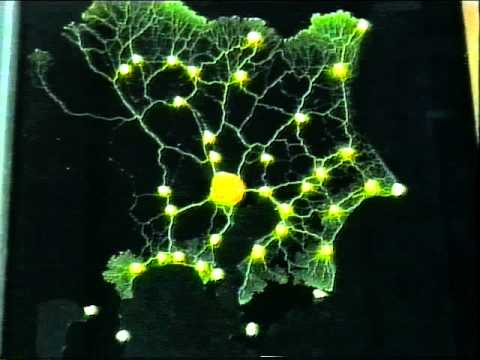
One of the most compelling studies was a group of scientists from both Japan and the U.K. collaborating at Hokkaido University (Takagi, Tero and Saigusa) , wherein seeking to explore the intellective abilities of this single-celled amoeboid made a groundbreaking discovery. In this experiment, oat flakes were placed on a wet surface corresponding to cities surrounding Tokyo; physarum polycephalum was set loose in the center. The genius of this slime mold comes in the process of its function, which operates by foraging for food sources by branching out randomly at first, leaving a chemical trail behind it like a slug, which later enables it to remember where it’s been; in essence ‘mapping’ its surroundings. Once a food source is identified (found), this intelligible protist surrounds its newfound resource and proceeds to build a ‘tunnel' that interconnects these nutrients together to form a repository for the organism to siphon and feed upon, and not just randomly; efficaciously. They watched, as the slime mold self-organized, spread out, and constructed networks of ‘nutrient-channeling tubes’ comparable in design, reliability, and cost to the real-world infrastructure of Tokyo's real world train network; after just 24 hours. Can you see the implications? Talented and dedicated (human) engineers, architects, and professionals spent countless hours-on-end designing Japan’s rail system, which is considered to be one of the world’s most efficient. Could it be true that all we had to do was ask the slime mold how to do it?
From an epistemological standpoint, using Descartes' questioning and reason, in-turn derived from the Socratic methodologies, we can postulate many things; yet assume none. If we follow the train of thought that the mind is a thinking thing, one that is not a material thing; by deduction, we can say that the mold we study has a mind of its own, while a brain is not present to be observed. Further, we find in the experiments mentioned the functions of reason and deduction, memory and logic; therefore leading to another meditation: Human Nature. While we can observe behavior and patterns of function in this primal intelligence of the goo, we cannot help but ponder the mirror in cognitive evolution. In theory, we should hold a place on the most opposite side of this spectrum; placing the mold-jelly on the lowest end, and human beings on the highest. In this continuum then, by logic, it must hold true that we are the most advanced living organism on this planet; that we know of. How then can the mold exhibit so many superior characteristics of virtue and morality? Holding right even to the rules of ethics, which we now find almost absent or muted in our human interactional behaviors at present day, is this not an evolutionary defiance?
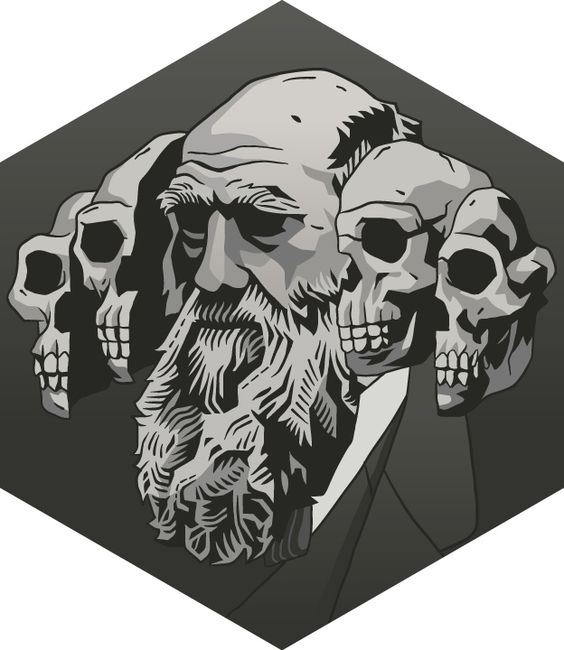
Shouldn’t our evolution, according to Darwinian Theory, proceed according to the survival of the fittest? Existing in fierce competition for scarce resources, and happening randomly and ruled only by chance? How then can this ‘primitive’ intelligence exhibit altruistic behaviors in complete contradiction to modern human behaviors? Does this provide unequivocal proof of the ‘devolution’ of Human Nature in our present state?
From slime mold we can learn much in the form of re-discovery of the natural human potential built in and present in all of us. The only difference between the one-celled slug and the complex cellular system of the human being, in philosophical terms of cognition and being, is the introduction of the ego and the idea of the self-centered or ‘egotistical' gene. As human beings, we appropriate the ego to the driver's seat, while we relegate our built-in sense of collaborative or biological altruistic imperative to a standby witness, at best. As proof, there are immaculate examples of the ability to override this function, by what we perceive as humans to be extraordinary beings like Socrates, Copernicus, Leonardo DaVincci, Mozart, Mother Teresa, Gandhi, Einstein, Tesla, etc. All of these individuals felt like they were part of a ‘collective consciousness' which all interpreted differently (some as faith, others as art, or science), as they felt a call to a higher purpose, an altruistic one—for of the betterment and survival of the species via the anima of both physical and spiritual needs.
At the heart, in the moral of this story, I posit there is a parallel in the stories of my elders. When a grandfather tried to explain the strength of a tribe to a young apprentice he told the young boy, "Bring me that stick over there that is dry and brittle, and then try to break it in half," the boy did as he was asked and proceeded to break the stick easily. The elder now instructed the young boy to gather as many dry sticks as he could hold in the clutch of his hand. He then told him to try and break all the sticks within his grip in half, all at once. As the boy struggled, he said, "Grandfather I cannot even bend the sticks! They are too strong", to this the grandfather replied, "So too is our tribe when we work as one."
In conclusion, I attest that this exercise of the mind has left me excited and renewed with hope, that indeed the Human Condition may yet reach its full built-in potential. It seems that we have experienced in our recent past a modern ‘dark age' period, such as ones from ages in history, during which human consciousness appears to stunt its advancement, and retracts into selfish realms of being. Similar to the controlled experiment, where the slime exposed to periods of stress in anticipation, it stunted its growth--I find the human collective has done the same. Perhaps from these experiments, we can further gain insight into the implication that we are but individual pieces, like the mold nuclei, in the grand collective of the organism, that like the original example we have observed, make a whole.
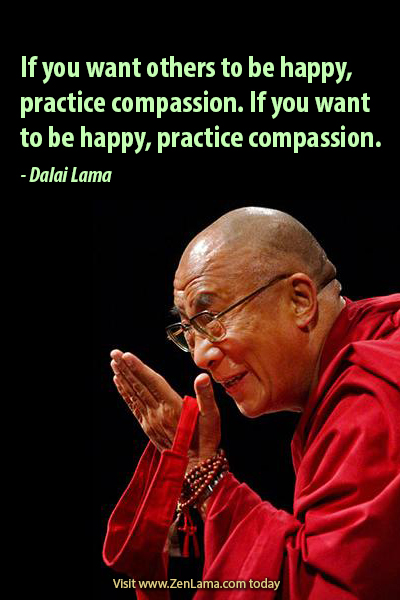
No matter what spiritual path or belief you follow, one of the major vitues in the practice is Human Compassion. Perhaps it is because we witness so much suffering around us, maybe there is an innate need to reach out. But the most important thing of all is to primarily UNDERSTAND the meaning of Compassion, and then once understood putting it into practice is another challenge all together! In my personal examination on this subject, I have come to find that interpretations are many, and explanations are almost none. So in my rants this week, let us attempt to place a dent in the subject.
Let us start by breaking down the etymology (origin) of the word COMPASSION. COM = Latin root Cum (meaning WITH) PASSION= Related to the English noun for Patient and the Greek Paskhein (meaning ONE WHO SUFFERS). Therefore, the word 'Compassion' literally means TO SUFFER WITH. More than that, compassion is the act of going out of your way to help relieve the spiritual, physical, or emotional pain of another. It is more than just Empathy, even though these emotions do go hand-in-hand. Instead, compassion incites a 'passion' like a fire that kindles brightly and is an automatic response to bearing witness to another's suffering.
Often times now in modern life we have become so jaded, and so encapsulated in our own bubbles that we walk about ignorant to the plights of others. Sometimes, even avoiding ourselves from encountering any of "those" situations for lack of "convenience. We change the channel, or roll up the window when we see a homeless man walking up to our car with a change cup asking for money. We look away and pretend we don't see it. Maybe we rationalize that if we ignore it, then it is not there. How passe! Yet the truth of the matter is, that when most people are faced with an imminent emergency, in the face of witnessing human suffering, it has been my experience, that something 'clicks' in people, and they experience compassion. As a matter of fact, I have stared into the face of EVIL, had a gun to my head, and through the act of human compassion (and providence I am sure) I connected with that individual. Needless to say I am here to tell the tale. So what exactly is human compassion? Why is it so special? and Why do some covet it so much?
Philosophers Descartes and Spinoza have said the following:
Descartes: "Pity is a sadness mixed kind of love or goodwill to those we see suffering some evil that we feel unworthy" ( Passions of the Soul , Article 185). Spinoza: "The pity is sorrow with the accompanying idea of evil happened to another we imagine like us ..." ( Ethics , XXII proposal and defining conditions, XVIII).
The common denominator here is that we feel somehow that in witness of a tragedy or an evil we feel is unnecessary, it is instinctive to react with the want to make things better to alleviate this suffering. Mother Teresa explained this when she was asked by a reporter about the purpose of her work. About why she decided to go work in the slums of India, among the 'undesirables' and the 'untouchables' and the dying. What did she hope to accomplish? and how did she plan to make a difference in such a vast pool of necessity that seemed never ending. To this loaded question she simply answered that she was not there to heal the sick, or make nurse anyone to health; that would be naive since she had not medical training of the body. However, she did feel like she knew something about the treatment of the spirit's health. She said to a reporter once "I am here simply to bear witness. To offer a human touch, and warm embrace to those whom would otherwise die alone and scared. To offer a blanket or water to the terminally ill, and give them dignity in their end. I am here to give compassion. Healing of the Spirit." Those words choke me up! What a lion of a lady and exemplary human being.
Of course there are extents to what each individual is capable of. In our learning as life scholars we learn bit-by-bit, as toddlers do to walk, how to become better spiritual beings. One does not have to be religious to be a spiritual person. The Dalai Lama is supposed to be an aspect of the Buddha's compassion, and an embodiment of the virtue itself. Mother Teresa certainly did not allude to sainthood in life. She admitted she was imperfect, and often in the face of so much death and human suffering she experienced darkness in her soul, and often questioned the resolve of her faith. She always felt she could do more. Gandhi led the liberation of India through compassionate means. Martin Luther King faced his adversaries and offered them love and understanding, after having gone to visit Gandhi by the way. So why not take a page from the Bible even, and in the words of Jesus of Nazareth "Turn the other cheek."
One thing is for sure, in a world where the media has exploited our heart strings, and in rotation display of the simultaneous suffering of the world being broadcast to us 24/7 on a screen, on social media, on blogs, through streaming, etc... we have become COMFORTABLY NUMB, like the Pink Floyd song. It is time to wake up as a human "race" and unite and connect to strengthen and reinforce our collective capacity for compassion. We cannot fix the world in one day, and we cannot help everyone all at once alone. Together however, if we cannot help the many, then help the one. Start somewhere. So something. Make a change.
Ralph Waldo Emerson, one of my favorite poets and thinkers encompasses it all, he writes:
It was late at night on a Wednesday, my eyes were red and burning, from staying up and staring at the screen all day. I had spent many hours writing technical reports, and intensely using both right and left sides of my brain, to function effectively in my grant and program writing evaluations. I decided to take a break and watch something banal, in order to distract my mind. Usually I go for something dramatic, scary, or filled with intrigue, so that I can get drawn in and ultimately distracted from the stress at hand. Playing tricks on my conscious mind to distract it.
Where better to watch random (sometimes useless) videos, on endless subjects than YouTube?
I quickly found a video interesting on the "Truth behind Scientology". It is a very interesting video (link below), and psychological exercise in a mass social experiment, into the inner workings of the mind. But that was not the most memorable thing to happen to me yet. It was not until I reached 20 minutes into the video documentary (total about 1 hr) that I was shocked to see how gruesomely distant the story got from its original intention. I would say it was 2 different stories pasted together, into one documentary. One had nothing to do with the other; that is to say--not in an obvious way for an audience. What I saw, was the documentary divert away from the mind control angle, and abuse inflicted by Scientology leaders on their flock, along with the massive elite protections they enjoy while doing it; to a profile of "The Beast of Belgium" Marc Detroux.
Who is Marc Dutroux? Born in Belgium, on November 6th 1956. He is a serial killer, child molester, and rapist. In 1986 he was arrested for kidnapping and raping five young girls. He was released after just 3 years out of a 13yr sentence, by Belgian Minister of Justice (which we would find out later was also part of the same pedophile ring). In 1992, just about 3 yrs after his release, Dutroux's own mother wrote to the Belgian prison director to state that she believed her son was keeping girls hostage and hidden in a cellar under his home; no one ever looked into it--until it was too late. 3 months later they were found dead. Failure of Justice? or Justified Failure in behavior due to his mental illness (obviously)? THIS was the memorable part of my day. Stumbling upon this discovery, was indeed a jewel in the study of the mind, and the "why" people do the things they do.
Consequently, this got me thinking along the following train of thought:
How broken does a mind have to be, in order to justify atrocities as normal? How detached from reality? What kind of pain does a mind have to endure before it cracks? Can one be born like this, with no empathy or regard for life, with sociopathic tendencies? Originally I was a contender of "inherited" wisdom, or knowledge of the mind, that could be passed down by DNA in the form of "genetic intelligence", and I still am in a way (more on that later); however recently, in my own children, I have noticed patterns of behavior that have NOT met this criteria. In my opinion, as a product of their environmental surroundings, developed while away from me for several years, my children lost or "shunned" (or stunted) their inherit genetic intelligence and in turn exhibited behaviors abnormal to our flock. I will give you an example of what I do NOT mean. The son or daughter of a law enforcement officer, that constantly get into trouble with the law. This is exhibiting defiance and psychological behavior that is relevant to personal and sociological reasons. Instead, I refer to the child of a genius, that grows up in a nurturing and educationally induced environment, and still falls off the map on a level less than average. When a mind that is primed for input, whether by genetic design or environmental factors, it is like the saying goes..."it's just like riding a bike; you never forget." So how then is it, that one can fall into such disrepair of the mind, and then willfully dull or dampened the senses? Or is there by definition no answer to this question, because indeed we do NOT posses genetic intelligence, and all intelligence is learned by environment. What do you think?
Let us not stop here in our pondering of the mind. We have explored the dark recesses, now let us explore the opposite side of the spectrum--being a genius. Quite provocative, and and enigma all by itself as a concept. What constitutes a genius? How can ONE person have such extraordinary abilities, while others remain "average"? Let us look into the phenomena of the Genius.
What makes a Genius or Savant?In 2002, outside a karaoke bar near Tacoma Washington, a man was attacked and brutally assaulted, sustaining head injuries that would later render him a mathematical genius, after awakening in the hospital. "I see shapes and angles everywhere in real life" — from the geometry of a rainbow, to the fractals in water spiraling down a drain, Padgett told Live Science. "It's just really beautiful." Apparently, the head trauma sustained unlocked a part of Padget's brain, that allows him to see everything that surrounds him in a mathematical structure.
There are other cases of sudden genius...
In 2006, 39yr old Derek Amato sustained a head injury, when he slammed head first into a concrete pool floor. Emerging as a musical prodigy, Amato was diagnosed with "Aquired Savant Syndrome". He states he suffers from severe headaches, abnormal vision, and he only feels at peace and calm when he plays music; like many other geniuses (or savants) that inherently develop OCD or a compulsion to perform, produce, or use their skill.
John Sarkin, a chiropractor that developed a brain tumor and after brain surgery became a "Savant". Suddenly after his stroke he saw the world differently, more vivdly, and he developed an obsession to create art; becoming a famous contemporary American artist.
According to Berit Brogaard, a neuro-scientist and philosophy professor at the Center for Neurodynamics at the University of Missouri–St. Louis, and her colleagues scanned Padget's brain to understand how he acquired his genius, and said "Acquired savant syndrome is very rare," adding that only 15 to 25 reported cases have ever been described in medical studies. Her research contends that when brain cells die, they release a barrage of neurotransmitters, and this deluge of potent chemicals may actually rewire parts of the brain, opening up new neural pathways into areas previously unavailable.
"Our hypothesis is that we have abilities that we cannot access," Brogaard says. "Because they are not conscious to us, we cannot manipulate them. Some reorganization takes place that makes it possible to consciously access information that was there, lying dormant."
Allan Snyder, a neuro-scientist at the University of Sydney in Australia. Since 1999, Snyder has focused his research on studying how their brains function. He's also pressed further into speculative territory than most neuro-scientists feel comfortable: He is attempting to produce the same outstanding abilities in "normal" people with "undamaged" brains.
In 2013, Snyder published what many consider to be his most substantive work. He and his colleagues gave 28 volunteers a geometric puzzle that has stumped laboratory subjects for more than 50 years. The challenge: Connect nine dots, arrayed in three rows of three, using four straight lines without retracing a line or lifting the pen. None of the subjects could solve the problem. Then Snyder and his colleagues used a technique called transcranial direct current stimulation (tDCS). The noninvasive technique, which is commonly used to evaluate brain damage in stroke patients, delivers a weak electrical current to the scalp through electrodes, depolarizing or hyperpolarizing neural circuits until they have slowed to a crawl. After tDCS, more than 40 percent of the participants in Snyder's experiment solved the problem.
The experiment, Snyder argues, supports the hypothesis that the abilities observed in acquired savants emerge once brain areas normally held in check have become unfettered. *The crucial role of the left temporal lobe, he believes, is to filter what would otherwise be a dizzying flood of sensory stimuli, sorting them into previously learned concepts. These concepts, or what Snyder calls mind-sets, allow humans to see a tree instead of all its individual leaves and to recognize words instead of just the letters. "How could we possibly deal with the world if we had to analyze, to completely fathom, every new snapshot?" he says.
Savants can access raw sensory information, normally off-limits to the conscious mind, because the brain's perceptual region isn't functioning. To solve the nine-dot puzzle, one must extend the lines beyond the square formed by the dots, which requires casting aside preconceived notions of the parameters. "Our whole brain is geared to making predictions so we can function rapidly in this world," Snyder says.
"If something naturally helps you get around the filters of these mind-sets, that is pretty powerful."
Daniel Temmet, born January 1979 suffered severe seizures as a child, which he eventually out-grew after treatment. He is Autistic, and he is a savant who speaks 7 languages; once learning a new language in a few days. Temmet is a mathematical genius who can figure out cube roots quicker than a calculator and recall pi to 22,514 decimal places. About 10% of the autistic community is a savant, and about 1% of the non-autistic community is. What if the electric impulses from the seizure, and/or the medical treatment, led to Temmet's savant abilities, just as a severe brain trauma "triggered" those in others?
Theory of Meta-Humans: The Savant Origin Story
Though I am a serious academic (I promise you!), I am also a great fan of science fiction, and the great story telling of Jules Verne, whom would come to inspire contemporary writers like Gene Rodenberry (Creator of Star Trek), and comic book counterparts. Consequently, sci-fi captures me because of the archetypes that can be seen in the profiles of the characters, and the process which is entailed in the "art" of writing or creating a new piece. I am fan of comic books in particular, due to the intricacy of the plots and the details in the background information offered about situations or protagonists. This is called an Origin Story.
In particular, Meta-Humans and their origins are of relevance to this discussion. In the DC comics universe (realm of stories), Meta-Humans are "enhanced" human beings, which for a myriad reasons (usually after a freak event/accident/stress), they suddenly develop "super-human" powers (abilities). Ring a bell? The equivalent for this term in the Marvel comic universe is In-Humans; in which innate "dormant" abilities lie asleep (in certain individuals), that manifest themselves as the subject experiences trauma or exposure to certain phenomenon. Is this what happened to the sudden "activated" savants of this story so far? Is this THEIR origin story? are they the first recorded (in modern times) cases of Meta-Humans? Leaving all "fantastic" notions of "Alien DNA" and sci-fi rants, think like a philosopher and like a scientist. Think of the 'why?' and think of the theories behind this line of thought, and think of the idea as a hypothesis based on facts. Facts that may be embellished and taken into the realm of sci-fi. But even in every lie there is a grain of truth.
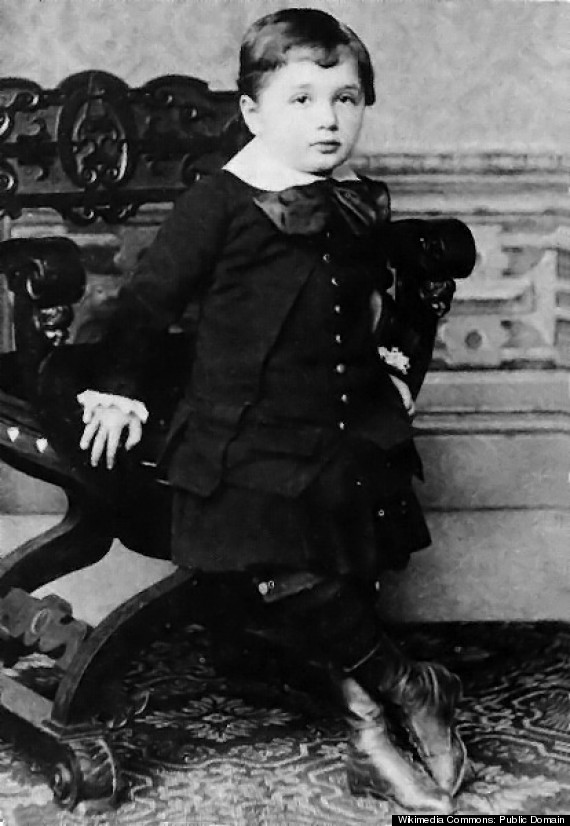
Albert Einstein, the consequential image of the modern genius, did not speak until he was three years old. It has been proposed that the expansion of his parietal lobes, especially in his speech-dominant left hemisphere, in effect intruded on his language areas; early language function was usurped by precocious mathematical and visuo-spatial capacities. Leaving behind the folklore figure of a genius who was slow to speak, Einstein’s early academic path showed great promise; he received the highest or next-highest marks in mathematics and Latin. In 1896, as a prerequisite to enrollment at Eidgenossische Technische Hochschule in Zurich, he obtained the Matura (a high school diploma) with superior grades in mathematics and the sciences but less than excellent results in technical and artistic drawing and geography. It becomes difficult to envision Einstein’s parietal lobe as the crucial element in his key theoretical constructs. Our senses cannot detect the curvature of space (as in the theory of general relativity) or the infinitesimal changes in time and dimension that occur with the velocities encountered in daily existence (as in the theory of special relativity). Einstein’s discoveries were not based on direct sensory experience but were pure thought experiments performed in his imagination.Such experiments are not easily reconciled with the current view of the parietal lobe as a provider of strategies to interact with and integrate direct sensory input from outside oneself.
Einstein was undeniably a genius, but to qualify him as a parietal genius is premature, based on our current and relatively primitive understanding of cortical function. Anthropologists assert that the great leap in technological sophistication, widespread cave art, clothes, and stereotyped dwellings occurred around 40 thousand years ago, even though the brain achieved its present size almost a million years earlier. We may follow a cultural mandate in studying the brain of a genius, but gaps in our knowledge of the physical and structural basis of cognition are humbling. What if there was another explanation? What if there are a combination of factors that make a genius, and therefore brain is NOT mind, and though "Genius" requires the right hardware, there are other factors at play in downloading information? Some people propose this theory as "The Collective Unconscious".
What is The Collective Unconscious?
Carl Jung, a modern psychiatrist that founded the principles we use today in analytical psychology, coined the tern The Collective Unconscious. Jung asserts that the term represents a form of the unconscious (that part of the mind containing memories and impulses of which the individual is not aware) common to mankind as a whole and originating in the inherited structure of the brain. It is distinct from the personal unconscious, which arises from the experience of the individual. According to Jung, the collective unconscious contains archetypes, or universal primordial images and ideas.The collective unconsciousis an universal datum, that is, every human being is endowed with this psychic archetype-layer since his/her birth. One can not acquire this strata by education or other conscious effort because it is innate. We may also describe it as a universal library of human knowledge (that lays mostly dormant), the very transcendental wisdom that guides mankind without our "conscious" knowing.
The Greeks believed that they were inspired by the "muses". This meant that when the muse (whom was a spirit of inspiration) was present, it was believed that they entered the individual, and then they were "Inspired" to create something grand or amazingly creative. Something worthy of a genius. If we break down the meaning and the etymology of the word "inspire" then "in-spirit" comes to mind! Filled with spirit (i.e. ideas). To this date, we say as writers/musicians/creative types "I am looking for my muse", implying we are looking for the keys to the kingdom of ideas that resides within each and every human being. Is it possible that by reaching this altered state of consciousness (untapped regions of our brain) we can come in contact with this collective of thoughts and knowledge, as a repository (pre-loaded), like a server, in an "idea" web? Perhaps only accessible to geniuses or savants?
The word genius originally derived from a Latin word meaning, ‘attendant spirit present from one's birth, innate ability or inclination,’ The original sense ‘tutelary spirit attendant on a person’ gave rise to a sense that ‘a person's characteristic disposition’ (late 16th century), which led to a sense of ‘a person's natural ability for unnaturally exceptional tasks’ (mid 17th century), hence bringing us to our modern definition of a genius being extraordinary, though we have forgotten the original insinuation that the ’genius’ did not come from an individual’s brain, rather there is a notion that this ’access’ to inspiration comes from an outside influence, as implied by the definition of the ’attendant spirit’, following the train of thought of the muse in Greek mythology. Is there any credence to the theory?
Albert Einstein had the ideas that inspired his theory of relativity (E = mc 2) in a dream, as he often cited was his process for solving complex formulas.
In 1865, Friedrich August Kekulé solved the riddle of the benzene molecule while in a day dream trance.Then there is the amazing story of brilliant Russian chemist Dimitri Mandeleev, whom discovered the periodic table of elements. Of his inspiration, Mandeleev is not shy to say... “In a dream I saw a table where all the elements fell into place as required. Awakening, I immediately wrote it down on a piece of paper.”
There is a Hindu belief in a collective unconscious of their own, which they believe contains a matrix of consciousness where all gnosis that is, and ever was, is present and existent available to anyone that can access its database, the subject of which (on how to obtain that) is of great debate. The virtual ethereal repository is called the Akashic records, or Book of Life. It is said that only those chosen by the gods may enter this realm, or those whom have obtained enlightenment also roam that realm of consciousness, which functions on a higher plane of existence, as is the tradition in the Hindu belief system.
Modern research studies also suggest that Alpha waves in the brain are produced when a person is in a state of calm, or trance, indicating no immediate conscious thought, but implying that the brain is accessing other realms of function. It has been suggested that geniuses have an innate ability to manipulate the intensity, or are more receptive by design, to alpha waves, which in turn may be the frequency of access to the repository of genius. Like a receptor that is activated, or virtual antenna that grows out of the psyche of our mind, altered by the structure of the brain. Deep stuff!
Now let me throw a monkey wrench in this grand theory we just tied up neatly in a bow; What about the geniuses that accessed the collective at the same time, for the same idea? Like the collective has a mind of its own, and it wants an idea or theme to manifest at given intervals of time. In February 1876, Alexander Gram Bell applied for a U.S.patent on a harmonic telegraph, a device that can transmit vocal sounds. At the same time, Elisha Grey, another scientist, had previously filed for the same type of device, which would eventually become the modern telephone. In fact, the synchronicities were so over the top, that each genius accused the other of stealing their ideas, and even went as far as suing each other in court; only to have the courts decide it had been a case of independent simultaneous invention (download). Curiously, simultaneous invention is not that uncommon.
On 1922, two Columbia University sociologists, William Ogburn and Dorothy Thomas, published an academic paper entitled Are inventions inevitable? Their research found at least 148 instances of simultaneous invention, all without knowing of their counterparts research or process. Ogburn and Thomas concluded, that if the geniuses had died and never made public their discoveries, or never even invented them, that another genius would thus be triggered by the collective to download, or invent that notion around the same time. Thus concluding. that maybe there is some sort of information floating in the air, that perhaps some human beings, like geniuses, have access to. What is your opinion?
Steve Jobs, the inventor of Apple and the iPhone, openly says that he first got the ideas, for what would transform the world as we knew it with technology, while meditating in a Zen Buddhist temple in the California Mountains. He constantly performed zen meditation, as he says he felt his thoughts quiet down and his mind gain access to other realms of inspiration, which existed outside his body. "Your mind just slows down and you see a tremendous expanse in the moment. You see so much more, than you could see before." Did Steve Jobs inadvertently, in the creation of the iPhone, mirror the macrocosm of the human consciousness and how it functions? In giving the world the iCloud, as a repository of data, and in giving user interface through a qualified device, is this perhaps a parallel to how we access the collective or the Akashic records. In that, the theory states that just because you own an iPhone it does not mean it holds all the knowledge of collective society within it, however it CAN connect to the internet, where it will have access to the raw data. Thus, the iPhone is the right hardware, to interface or access the internet data, similar to the genius that has access to invention or creative innovation.
Now fast forward two days later, after our story first starts with my eyes burning, from being over worked. After 2 days of pondering all the above discussion, I again find myself engulfed in a task. This time it was a philosophy book, and I was reading about Truth. In it, the opening chapter reads: 'What is Truth? And then the paragraph starts... In 2002 a Belgian jury found Marc Dutroux guilty of murder....'What?--Synchronicity anyone?--The article goes on to discuss an officer's testimony in court that stated that he had left evidence for the judge to review in regards to evidence to issue a warrant, and the judge lied about never receiving it, insisting it was hand delivered to his office. The judge, on the other hand, states under oath that he never received such video evidence, and that he did not abscond any evidence, he simply did not get it. Each accused the other of corruption and bias. The argument placed in front of me was there are objective truths, relative to the individual whom experiences them. That there is no transcendent truth, and that in fact there are only partial truths and that Truth is relative. In the book I was asked to analyze the following statement, and this got my wheels turning... (I promise this all relates to our discussion--hang in there.)
Do you think that there are two kinds of truth, subjective and objective, truth as an individual perceives it, and truth as it actually is?
This was my official answer:
Yes I do believe there are two kinds of truths. As the text relates, I am in agreement that Truth is relative to the one who experiences it. And two people may experience the same truth differently. Consequently, if each individual has been subjected to the exact same circumstance, how can both perceive it to be un-alike? The short answer is PERCEPTION. The longer version is a subject for another post (that is the PERCEPTION of reality subjective to the persona of the individual as the experiencer). So to re-cap, subjectively the truth belongs to each of us alone, and while will concur others will undoubtedly not agree.
Objectively, there exists another truth, and ultimate truth; hence the role of the "Judge" or "Arbiter". By definition this truth implies to be related to, and inevitably linked to the material facts and truths of both language and experience. It is a way of looking at things from "an outside perspective" as an observer, much employing the Socratic method in rational questioning, in order to obtain what is perceived as the ultimate truth. Under this theorem our justice system is supposed to be based on. Most of our system comes from the ancient Athenians, which we know were influenced by the great thinkers-geniuses of the day (i.e. Socrates and others.. hint hint)
“. . . the mind connects and unifies its sensations into a unified world of interrelated objects because it must.” Does this remind you of Dr. Allan Snyder?*
I believe that the mind is a thinking thing, in other words, it wants to "make sense" of what it sees, feels, or experiences. Similar to the way that we have invented computers to function. There are parameters that the brain follows to compute the experiences that we take in. When something is out of context, or it does not make sense, our mind goes into "does not compute" mode, and this translates to migraines, strokes, and all sorts of other physical manifestations of this dilemma. SO in my opinion, the statement implies, that because the mind has tendency to look for or correlate experiences to the "sensible" world it knows, it will always seek to make order of the chaos.
How does George Berkeley's theory of Subjective Idealism support or refute the ideas expressed in the statement?
Berkeley asserted that there is no reality but that which is experienced subjectively by the beholder. In that sense this statement would not be in support as it implies a "unity" of thought or absolute idealism. To what extent do the ideas of primary and secondary properties support or refute the quote? For Locke, primary qualities are those that are NOT related to the subject: Size, Shape, Solidity. Secondary properties are more the things that cause a sensation or reaction out of the subject: Color, Taste, Smell. Primary and Secondary properties therefore, would apply to this quote in that it states that the sensations of the mind are unified in the world of interrelated objects, and in turn these sensations could be attributed to , and or analyzed or perceived as primary and secondary to experience.
How do I know what I know? and the processes that we recognize as knowledge
Because I am a Rene Descartes die hard fan, I have to include him when discussing philosophical models. I am of the school of thought of his methods, although I do subscribe to some empirical ones, but my heart lies in rationalism. In regards to how we "know" what we know, it is hard to say. I used to be of the idea that most character traits or "quirks" are inherited, however we already discussed how I have concluded otherwise. Then there is the findings of William Ogburn and Dorothy Thomas in 1922. Hmmm....
I hypothesize that just EXPOSING a subject to the information is NOT enough to teach or learn how to be a genius inherently. That in order for the perceiver to LEARN or KNOW what you want them to, a click must occur in which the mind engages into physical action after the mental exercise is completed. This goes back to the singularity of the common traits of all geniuses, in my opinion they can all access this greater knowledge because something clicked in their brain to activate that ability. In addition, I can extend my theory to include that there is indeed an innate quality that lies dormant in most human beings, sleeping in the dark is this inaccessible WiFi router that needs a password to access the encrypted network of worldly gnosis, or as Carl Jung puts it, the very transcendental wisdom that guides mankind. Could this be so?
Synchronicities and Conclusions...
I promised you to tie this all up neatly in a bow. The fact is that I started this article for my blog, with the intention to only discuss the mind, both the dark recesses that entertain atrocities, and the opposite spectrum that is the phenomenon of being a genius, and all things knowledge. I am more interested in the thoughts behind the behaviors, and the archetypes we see repeated like patterns--left like clues in a puzzle--than the acts themselves that these opposite sides of the spectrum have performed. Yet, I at the beginning I throw a banal story about Marc Dutroux and it seems like it is out of context, and totally does not fit in with the rest of the subject matter--until it appears again towards the end of this article. But there was too much coincidence to ignore!
Now, understand that as a serious writer, what I should have done, and almost did, was delete all references to Dutroux, and compiled the article without that info. Instead, I felt it so essential to my point, that I left it in at the possible cost of loosing my readers in the beginning, and risking that not everyone might guess the inferred connection. Hence, why I chose to write this re-cap. The Dutroux phenomenon, as I have come to call it, floored me, especially as I ran across it as described, and let me add now an additional piece to the narrative... right after the Dutroux story had danced its way across my field of vision twice in one week, in unrelated circumstances, or content, I then had a moment of insight. There had to be a significance to the Dutroux story, a connection that I could not identify right away, like Dr. Snyder and his experiment on problem solving.
Finally, after I reached a point in my train of thought, and in my readings, when I was pointed to the collective unconscious--that is when it all came clear. It was my proof, my personal experience to attest to the phenomenon is REAL. Without knowing I had just been witness to the most amazing quirk in life, proof of living intelligence with a design. Not many get that validation in their life of a theory of that scope. It was as if the Universe was speaking to me. Yes I know it is cliche to use the words... but it is TRUE!
Maybe I am influenced by my spiritual beliefs, and maybe that is where my rationalism ends and my blind faith begins, but being part Native American and believing in traditional teachings does not allow me to think of the world, or the universe for that matter, in a jaded, or static way. I believe it is very similar in most native, or primal cultures. The Koori, whom are Australian aborigines, live in a primal reality that is all-encompassing including past, present, and future, all in one. The belief system is that creation was done in a realm of fluidity and this world was created in a more static form, where we have things and concepts like gravity, time, and space. We are constrained by those boundaries, unless we enter the dreamtime, through which all aspirations are possible. Not a day dream, or even a vivid dream, but more of a lucid dream, with qualities of having tangible events influencing connective events in real time on earth plane existence being manifested. That is the purpose of the discussion of Truth, and how it is relative.
Carl Jung stated that the religious experience must be linked with the experience of the archetypes of the collective unconscious. Thus, God himself is lived like a psychic experience of the path that leads one to the realization of his/her psychic wholeness. The collective unconscious - so far as we can say anything about it at all - appears to consist of mythological motifs or primordial images, for which reason the myths of all nations are its real exponents. In fact, the whole of mythology could be taken as a sort of projection of the collective unconscious... We can therefore study the collective unconscious in two ways, either in mythology or in the analysis of the individual. (From The Structure of the Psyche, CW 8, par. 325.)
I think we know what we know NOT by the perceptions we walk away with, but with the actions we sense and experience instead.
On Feb. 25, 1953, in a letter to Carl Seelig, the Swiss author and journalist who wrote a biography of Albert Einstein. Jung wrote, "Professor Einstein was my guest on several occasions at dinner. . . These were very early days when Einstein was developing his first theory of relativity [and] It was he who first started me on thinking about a possible relativity of time as well as space, and their psychic conditionality. More than 30 years later the stimulus led to my relation with the physicist professor W. Pauli and to my thesis of psychic synchronicity."
Following discussions with both Albert Einstein and Wolfgang Pauli, Jung believed that there were parallels between synchronicity and aspects of relativity theory and quantum mechanics. Jung was transfixed by the idea that life was not a series of random events but rather an expression of a deeper order, which he and Pauli referred to as Unus mundus. This deeper order led to the insights that a person was both embedded in an orderly framework and was the focus of that orderly framework and that the realization of this was more than just an intellectual exercise, but also had elements of a spiritual awakening. From the religious perspective, synchronicity shares similar characteristics of an "intervention of grace". Jung also believed that in a person's life, synchronicity served a role similar to that of dreams, with the purpose of shifting a person's egocentric conscious thinking to greater wholeness.
So what do you believe now? To be or not to be, suddenly is not the question... but the answer!
What is the difference, between Religion and Spirituality?
As a woman of mixed ethnicities and cultures,it is not hard to place both hats atop my head, after all I was raised under Native American faith, and then moved to Mexico, where I was converted and raised in Catholicism, until the age of 12. I returned to my Mother's Native American spirituality at age 13. On my father's side mostly everyone is driven by logic, reason, and empirical science. The family, though not atheist, delving into subvert societies did occur in the family history. Can you see the complications in the dogma occurring? Just wait... there is more. I later married for the second time into a family that was deeply into the dark arts, little to my knowledge until all was revealed to me after marriage. I married a third time, and this time to a devout Muslim. I never saw myself as an international religious-sampler-type, but this is how life happened to me. So now, can you imagine what my personal religious and spiritual dogmas consist of?
Along the way in my professional life, as well as my artistic one, I have run into a myriad of individuals that follow an abundance of paths to what they consider "faith". Faith is universal to either Religion or Spirituality, so what is the difference between both? Well, though I am not an expert, by any means, and hold no theology degrees, I can refer to my own personal experience, and that of others whom have shared with me their views and opinions.
Many people, have many view, and many passionate opinions and ideas on the subject.
This is my take on the matter...
In the Christian dogma, as in all the Abrahamic religions in particular (Judaism, Islam, Christianity) there is a particular importance placed on "scripture" and a rigorous set of beliefs and a system to follow it. There is a system for judgement in order to obtain "salvation", and there are penalties for not following doctrine. Rules change from branch to branch of the religions in particular, as to penalties, severities, and rewards, but the overall system is the same. There are priests (intermediaries), and there is a church, or place of worship, where people gather for sermon. That is the quick picture.
In Native American Spirituality, our church is the land, it is IN nature. In our fields, in our huts/kivas/hogans made from earth materials, in our tipis made of skins, or our caves carved from mountains, that is our gathering place for prayer. There are no penalties for saying the wrong prayer, there is no HELL or consequence for NOT attending our church, for we LIVE in it. We cannot help but be connected to Creator, because we are in daily contact with the creation. In the wind we breathe, in the water we drink, in the sun we feel on our skin, that is all Creator's gift.
Deloria's statement: “Religion is for people who’re afraid of going to hell. Spirituality is for those who’ve already been there.”is too often mis-interpreted. Vine Deloria Jr. was a Native American Author, Theologian, historian, and Activist. He was famous for the book Custer Died for Your Sins: An Indian Manifesto (1969), which helped bring much needed attention to the Alcatraz-Red Power Movement. He died November 13, 2005, but not before leaving a lasting legacy in the struggle and plight of the American Native Indian. Deloria served as executive director of the national Congress of American Indians, he was a board member of the Museum of the American Indian, he was professor of political science at the University of Arizona, where he established the 1st master's degree program in American Indian Studies in the United States.
Deloria's statement was a satirical, and philosophical one, not a literal one.
In my opinion the statement implies (from reading his many writings) that he separates the notion of Religion as a belief system(dogma) in which one seeks (regimented) salvation in order to "avoid" hell, which is somewhere else, while contrarily, in his opinion, Spirituality relates more to the individuality of worship, and the need for connection to the divine, due to the relief we seek from the torments of "hell", which in Deloria's opinion is the very existence (life) we live in. Hell is here and now, while practicing spirituality releases us from those torments, and prepares us for our journey in the existence we have ahead. This is but a step in the long journey of existence, and it is the hardest one.
WHY CAN'T WE HAVE BOTH?
Considering that in the world today we have a diversity that is not only apparent (as we are not globally connected before), but also inter-woven, and culturally inter-mixed. Gone are the days of old where sects, groups, and classes stuck together and to themselves. Nowadays we have all these wierd combinations, such as myself, and by experience I can say that tolerance of other's faith is not only possible, but necessary.
Why can't we combine all that we learn along the way, and like a map use it to build a model that we can call our own, and be comfortable with. As is, almost no one takes the prescription of their faith literally. There are those who do, however most DO NOT follow ALL things to the letter. Why can't we take what we know of Religion and Spirituality and conceive of our own faith? Can we not reach a happy compromise in our being? Afterall, are we here to prove our faith, or follow it? Are we here to perform for an audience of fellow adherents, or here to satisfy an inner desire for connection to the divine? Prioroties of the minds all come to play in this decision, because it is only when the right reasons are present that we can see past our own limitations of judgment.
One of the main components of the self is in knowing where one part of you ends and another begins. Parts, you ask? Yes, parts.
The self has multiple parts. We all develop many facets as we grow, and, of course, our whole is always greater than the sum of our parts. We develop personas as we encounter situations, events, places, people, and experiences. Think of the avatar on your social media page that reflects your mood or the “game face” you put on before a meeting or a visit with family. These are your personas. The number and type vary from individual to individual, but the fundamentals are the same. We temporarily “put on” these aspects of ourselves as the situation requires.
How do we know which one of our personas is the true self? What if we carried a bit of all of them in ourselves? What if we just shed these personas at the first opportunity? Only one question matters in the end: do youreally know who you are?
We go through life personifying who we are and who we want to be. Sometimes the two run together; sometimes they each go their own way. Our personas are interchangeable and can be manageable, but how do we keep our sanity while performing all these seemingly schizophrenic changes? This is where most people, myself included, inevitably get into trouble.
It is important to reflect not only on questions about your present but also on questions about your future. This will always give you a starting point. Always knowing that there is room for change, and that the present is never absolute, will become a subconscious motivator.
The key to understanding this phenomenon is to tackle it head on. The main questions are “Who am I?” and “Who do I want to be?”
“Who am I?” seems almost obvious and overly simplistic, but it is not. The question triggers myriad trains of thought. Who am I at heart? What are my desires? What drives me? All these questions arise from what seems like a relatively simple inquiry.
The next fundamental question is a whopper. Are you happy with who you are? Really happy? If the answer is just a question mark, as it was with me, the next questions you should ask yourself are these: “Why have I chosen the persona I have? When do I use it? Why? What part about the persona I choose do I feel is of benefit? Have I ever stopped to think of possible negative side effects? Even if they are acceptable side effects, have I really considered them?”
Only you can answer these questions. They are the questions that you do not allow others to ask or even insinuate.
The philosopher René Descartes penned my thoughts perfectly: “I am a thing that thinks, that is to say, a thing that doubts, affirms, denies, understands a few things, is ignorant of many things, wills, refrains from willing, and also imagines and senses.” Shakespeare’s phrase “to be or not to be” is not the question but is the answer.
“The glory of friendship is not the outstretched hand, nor the kindly smile, nor the joy of companionship; it is the spiritual inspiration that comes to one when you discover that someone else believes in you and is willing to trust you with a friendship.”
--Ralph Waldo Emerson
“The only reason for time, is so that everything doesn't happen at once.”
--Albert Einstein
"Money can help you to get medicines but not health. Money can help you to get soft pillows, but not sound sleep. Money can help you to get material comforts, but not eternal bliss. Money can help you to get ornaments, but not beauty. Money will help you to get an electric earphone, but not natural hearing. Attain the supreme wealth, wisdom, and you will have everything."
--Benjamin Franklin
"To put the world right in order, we must first put the nation in order; to put the nation in order, we must first put the family in order; to put the family in order, we must first cultivate our personal life; we must first set our hearts right."
--Confucius
"Yet each man kills the thing he loves, from all let this be heard. Some does it with a bitter look, some with a flattering word. The coward does it with a kiss, the brave man with the sword."
-Oscar Wilde
Each of us is here to discover our true Self--that essentially we are spiritual beings who have taken manifestation in physical form--that we're not human beings that have occasional spiritual experiences--that we're spiritual beings that have occasional human experiences.
--Deepak Chopra
"I am a thing that thinks, that is to say, a thing that doubts, affrims, denies, understands a few things, is ignorant of many things, wills, refrains from willing, and also imagines and senses."; "I think; therefore I am." ; "The only secure knowledge is that I exist." ;